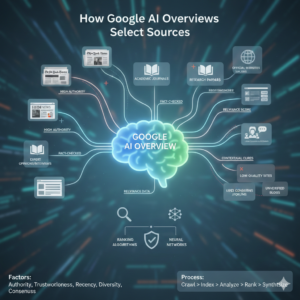
Search has undergone its biggest transformation since Google was founded. In 2026, users no longer rely only on traditional blue links to find answers. Instead, Google increasingly provides AI-generated summaries called AI Overviews, which appear at the top of search results and directly answer user questions.
These summaries don’t come from nowhere. They are built using information selected from across the web. But one of the biggest questions for publishers, SEO professionals, and content creators is this:
How does Google AI Overviews decide which sources to select and cite?
The answer lies in a completely new system that combines traditional search signals with advanced artificial intelligence, semantic understanding, and real-time content evaluation.
This guide explains exactly how Google AI Overviews select sources in 2026, what factors influence selection, and what this means for the future of SEO and content visibility.
The Shift from Ranking Pages to Selecting Sources
To understand AI Overview source selection, you must first understand how it differs from traditional search.
In traditional search, Google’s goal was to rank web pages. Users would see a list of links and choose which ones to visit.
In AI-driven search, Google’s goal is different.
Instead of ranking pages, Google’s AI selects sources to generate answers.
This is a fundamental shift.
Google is no longer just a search engine that points users to information. It is becoming an answer engine that synthesizes information.
This means that being ranked number one does not guarantee being selected as a source for AI Overviews.
Google now evaluates content based on how useful it is for answering a specific question, not just how well it ranks.
Step 1: Understanding User Intent
The first step in the source selection process begins when a user enters a query.
Google’s AI analyzes the query to understand the intent behind it.
Intent refers to what the user actually wants to know.
For example, if someone searches:
“What is technical SEO and why is it important?”
Google recognizes that the user wants:
-
A definition
-
An explanation
-
Reasons for importance
This process is powered by natural language understanding systems that analyze meaning, not just keywords.
AI Overviews are typically triggered when Google determines that a summarized answer would be more helpful than a list of links.
These are usually informational, educational, or complex queries.
Simple queries like brand names may not trigger AI Overviews.
Step 2: Retrieving Candidate Sources from the Web
Once Google understands the intent, it begins retrieving possible sources that may contain relevant information.
This step is known as retrieval.
Google searches its index to find pages related to the query.
However, this is not limited to top-ranking pages.
Google retrieves content from across the web, including:
-
High-ranking pages
-
Mid-ranking pages
-
Specialized niche pages
-
Authoritative resources
-
Forums and discussions
-
Educational websites
-
Blogs and publishers
This means even smaller websites have the opportunity to be selected if their content is useful.
At this stage, Google creates a pool of candidate sources.
These sources are then evaluated further.
Step 3: Evaluating Relevance and Semantic Meaning
After retrieving candidate sources, Google analyzes how relevant each source is to the query.
This process goes beyond keyword matching.
Google uses semantic analysis to understand the meaning of content.
For example, Google evaluates whether the page:
-
Clearly answers the question
-
Provides useful explanations
-
Covers the topic accurately
-
Matches the intent of the query
Pages that provide clear answers are more likely to be selected.
Pages that are vague, promotional, or unclear are less likely to be used.
Google also evaluates whether different sources provide complementary information.
Since AI Overviews often combine multiple sources, Google selects sources that together provide a complete answer.
Step 4: Authority and Trust Evaluation
One of the most important factors in source selection is authority.
Google evaluates how trustworthy a source is.
This includes evaluating:
Website reputation
Content quality
Author expertise
Consistency of information
Historical reliability
Websites that consistently publish accurate and helpful content are more likely to be selected.
This is especially important for sensitive topics such as health, finance, and legal information.
Google applies stricter quality standards for these topics.
Trust signals help Google avoid selecting unreliable or misleading sources.
Step 5: Content Clarity and Structure
Google AI prefers content that is easy to understand and extract.
Content clarity plays a major role in source selection.
Pages that use clear structure are easier for AI to process.
This includes:
Clear headings
Logical organization
Direct explanations
Short paragraphs
Structured sections
Content that answers questions directly is more useful for AI generation.
For example, a paragraph that clearly defines a concept is more likely to be selected than a long story that indirectly explains it.
Google’s AI breaks pages into smaller sections and evaluates individual passages.
This means even a single well-written section can be selected.
Step 6: Information Gain and Unique Value
In 2026, Google increasingly focuses on information gain.
Information gain refers to how much new value a source adds.
If a page simply repeats information that already exists elsewhere, it is less valuable.
If a page adds new insights, explanations, or perspectives, it becomes more valuable.
Google prefers sources that contribute meaningful information.
This helps improve the quality of AI Overviews.
Unique, helpful content has a higher chance of being selected.
Step 7: Freshness and Content Updates
Content freshness also plays an important role.
For topics that change frequently, newer content may be preferred.
Examples include:
Technology
AI
SEO
News
Finance
Updated content ensures accuracy.
However, freshness is balanced with authority.
Older authoritative content may still be selected if it remains relevant.
Google evaluates whether content reflects current knowledge.
Step 8: Generating the AI Overview
After selecting the best sources, Google’s AI generates the overview.
This is done using advanced language models.
The AI reads the selected sources and synthesizes the information.
It creates a new summary that answers the user’s query.
The overview includes citations linking to the sources used.
This allows users to explore further if needed.
The AI does not simply copy content.
It generates new text based on understanding.
This process ensures the answer is clear and useful.
Why Some High-Ranking Pages Are Not Selected
Many website owners assume that ranking high guarantees selection.
This is not always true.
Some high-ranking pages may not be selected because:
They do not directly answer the question
They lack clear structure
They are too promotional
They are difficult to extract information from
Meanwhile, lower-ranking pages may be selected if they provide better answers.
This shows that AI selection is different from traditional ranking.
Why Some Smaller Websites Get Selected
AI Overviews have created new opportunities for smaller websites.
Even websites without strong backlink profiles can be selected.
This happens when content provides:
Clear explanations
Helpful structure
Strong relevance
Unique insights
Google’s AI focuses on usefulness.
This creates a more level playing field.
Quality matters more than size.
The Role of Entities in Source Selection
Google understands content using entities.
Entities are real-world concepts such as:
People
Companies
Technologies
Locations
When content clearly explains entities and their relationships, it becomes easier for AI to understand.
This improves selection chances.
Entity clarity improves semantic understanding.
The Role of Passage-Level Analysis
Google does not evaluate only entire pages.
It evaluates individual passages.
This means a specific paragraph may be selected.
This is known as passage-level retrieval.
This allows Google to extract the most useful parts of content.
Even long pages benefit if individual sections are strong.
How AI Overviews Are Changing SEO
AI Overviews are changing how SEO works.
Traditional SEO focused heavily on ranking positions.
In AI search, source selection is equally important.
Visibility now comes from:
Ranking
Citation
Authority
Content usefulness
This means content must focus on helping users.
Not just optimizing keywords.
The goal is to become a trusted source.
The Future of Source Selection
Google’s AI Overviews will continue improving.
Future systems will become better at:
Understanding context
Evaluating expertise
Detecting misinformation
Selecting high-quality sources
AI will become more accurate over time.
Source selection will become more refined.
Content quality will become even more important.
Conclusion
Google AI Overviews represent a major evolution in search.
Instead of simply ranking pages, Google now selects sources to generate answers.
This selection process involves multiple steps, including intent analysis, source retrieval, semantic evaluation, authority assessment, and AI synthesis.
The system prioritizes clarity, trustworthiness, relevance, and usefulness.
This means that content creators must focus on providing real value.
Clear, helpful, and authoritative content has the highest chance of being selected.
In 2026 and beyond, success in search will depend not just on ranking, but on becoming a trusted source that AI systems rely on.
The future of search belongs to content that truly helps users.