Search is no longer just about ranking #1 on Google.
Today, people are getting answers directly from AI tools like ChatGPT, Google’s AI Overview, and voice assistants like Alexa and Siri often without even clicking a website.
This shift has introduced new optimization strategies: AEO (Answer Engine Optimization) and GEO (Generative Engine Optimization).
As someone working in SEO and closely observing how AI is changing search behavior, I’ve seen how relying only on traditional SEO is no longer enough.
In this guide, you’ll learn:
- What is SEO, AEO, and GEO
- Key differences between them
- Real examples
- Which one matters most in 2026
- How I optimize my content for all three
SEO vs AEO vs GEO: Quick Summary
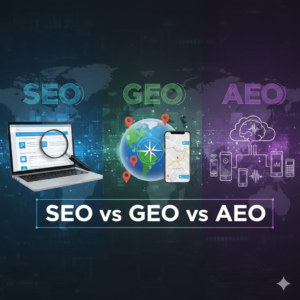
SEO helps websites rank on search engines and drive traffic. AEO focuses on providing direct answers that appear in featured snippets and voice search. GEO optimizes content for AI tools like ChatGPT and Google AI Overview, helping your content get cited and build authority.
What is SEO (Search Engine Optimization)
Search Engine Optimization, or SEO, is the practice of improving your website so that it appears higher in search engine results when people search for topics related to your content, products, or services. The higher your website ranks, the more likely people are to find it and visit it without you paying for ads. This organic visibility helps bring consistent and long-term traffic to your website.
For example, when someone searches for “best protein powder in India,” the websites that appear on the first page are there because they have been properly optimized using SEO techniques. Google considers many factors before ranking these pages, such as how relevant the content is, how trustworthy the website is, and how well the page is structured.
The main goal of SEO is not just to bring traffic, but to bring the right audience who are genuinely interested in your content or offerings. This helps improve your brand visibility, build trust, and generate leads, customers, or followers over time.
SEO involves several important elements working together. These include researching and using the right keywords that people are searching for, creating high-quality and helpful content, earning backlinks from other trusted websites, and technically optimizing your website so search engines can easily crawl and understand it. When all these elements are implemented correctly, your website has a much better chance of ranking higher and reaching more people organically.
What is AEO (Answer Engine Optimization)?
Answer Engine Optimization, or AEO, is the process of creating and structuring your content in a way that directly answers specific user questions, so search engines and voice assistants can show your content as an instant answer. Unlike traditional SEO, which focuses on getting users to click your website, AEO focuses on making your content appear as the answer itself.
For example, when you search “What is SEO?” on Google, you’ll often see a short definition displayed at the top of the results page, even before the website links. This is called a featured snippet, and the content shown there is selected because it clearly and directly answers the question. Similarly, voice assistants like Alexa, Siri, and Google Assistant read out answers from web pages that are optimized for AEO.
The main purpose of AEO is to increase your visibility by positioning your content as the most trusted and direct answer. This helps build brand recognition and authority, even if the user doesn’t click on your website. To achieve this, content needs to be written in a clear, structured, and question-focused format. Including FAQ sections, using proper headings, and giving concise definitions improves your chances of appearing in featured snippets, voice search, and AI-generated answer sections like Google’s AI Overview.
What is GEO (Generative Engine Optimization)?
Generative Engine Optimization, or GEO, is the process of optimizing your content so that AI-powered tools like ChatGPT, Google Gemini, and Google AI Overview use your website as a reference when generating answers. Instead of just ranking on search engines, GEO focuses on making your content authoritative and trustworthy enough for AI systems to cite it.
For example, when someone asks an AI tool “Best SEO strategies for beginners,” the AI generates an answer by analyzing information from various sources. If your website is considered reliable and valuable, the AI may use your insights or mention your brand in its response. This increases your authority and exposure, even if the user never directly searches on Google.
The main goal of GEO is to build strong topical authority and trust so that AI platforms recognize your content as a credible source. This requires creating detailed, high-quality, and experience-based content that genuinely helps users. Sharing unique insights, explaining topics in depth, and demonstrating real expertise increases the chances of your content being referenced by generative AI, which is becoming an increasingly important source of visibility in modern search.
SEO vs AEO vs GEO: Key Differences
While SEO, AEO, and GEO all aim to improve your visibility, they work differently and serve different purposes. Here’s a detailed comparison to help you understand how each one contributes to your overall digital presence:
| Factor | SEO | AEO | GEO |
| Full form | Search Engine Optimization | Answer Engine Optimization | Generative Engine Optimization |
| Primary goal | Increase website traffic | Provide direct answers | Get cited by AI tools |
| Main platform | Google, Bing search results | Featured snippets, voice assistants | ChatGPT, Gemini, AI Overview |
| Focus | Keywords and rankings | Questions and direct answers | Authority and trust |
| Output | Blue link rankings | Position zero / voice answer | AI-generated citations |
| User action | User clicks your website | User gets answer instantly | User sees brand mentioned by AI |
| Content style | Keyword-optimized articles | Question-answer format | In-depth, authoritative content |
| Importance of backlinks | Very important | Helpful but not primary | Important for authority |
| Importance of structure | Important | Very important | Extremely important |
| Visibility type | Search engine results page | Featured snippets and voice | AI-generated responses |
| Traffic potential | High direct traffic | Medium traffic, high visibility | Lower direct traffic, high authority |
| Brand building | Moderate | High | Very high |
| Time to see results | Medium to long term | Medium term | Long term |
| Future relevance | Evolving | Growing fast | Growing fastest |
| Example | Ranking for “SEO tips” | Appearing in “What is SEO?” snippet | Being cited by ChatGPT |
Real Example
Let’s say you write an article:
“Best Running Shoes for Beginners”
SEO outcome:
Your article ranks on Google and people click your website.
AEO outcome:
Google shows your answer in featured snippet.
GEO outcome:
ChatGPT recommends your article.
One article can achieve all three.
Why SEO Alone is No Longer Enough
Earlier, users clicked websites to get answers.
Now, AI gives answers instantly.
This means:
- Fewer clicks
- More AI answers
- More competition
If your content is not optimized for AI, you lose visibility.
This is why AEO and GEO are important.
Which is More Important in 2026
The truth is:
All three are important.
But their purpose is different:
SEO → Traffic
AEO → Visibility
GEO → Authority
The future belongs to businesses using all three.
How to Actually Optimize for SEO, AEO, and GEO (Step-by-Step Framework)
Understanding the difference between SEO, AEO, and GEO is important, but the real advantage comes from knowing how to implement them together. Here is the exact framework I use to optimize a single blog post for all three.
Step 1: Start with SEO (Foundation Layer)
Every content piece should begin with traditional SEO because it helps search engines discover and rank your page.
First, I identify the main keyword and related search terms people are using. Then, I include the keyword naturally in the title, headings, and content. I also make sure the article is well-structured, easy to read, and internally linked to other relevant pages. This helps search engines understand the topic and improves ranking potential.
This step ensures the content can rank in Google search results and bring organic traffic.
Step 2: Add AEO Optimization (Answer Layer)
Once the SEO foundation is ready, I optimize the same content for answer engines.
I add clear definitions, direct answers to common questions, and an FAQ section. I use simple language and structured headings so search engines can easily extract answers from the content.
This increases the chances of appearing in:
- Featured snippets
- Voice search results
- Google AI Overview
This step improves visibility even if users don’t click the website.
Step 3: Add GEO Optimization (Authority Layer)
This is the most important step for future search.
To optimize for generative engines, I focus on making the content more authoritative and experience-based. I include unique explanations, real examples, and original insights instead of just repeating common information.
AI tools prefer citing content that demonstrates expertise and trust.
This increases the chances of:
- Being cited by AI tools
- Building personal brand authority
- Becoming a trusted source
Step 4: Combine All Three in One Article
The real power comes from combining all three.
For example, in this article:
- SEO helps this page rank on Google
- AEO helps this page appear in answer sections
- GEO helps this page get referenced by AI tools
This combined approach makes the content future-proof.
Future of Search: SEO vs AEO vs GEO
Search is rapidly moving toward AI-powered experiences where users get information instantly without always visiting multiple websites. Traditional SEO is not dying, but it is evolving into a broader strategy that includes optimizing for answer engines and generative AI. The future of search will be shaped by three key shifts:
AI-driven search: This refers to search powered by artificial intelligence, such as Google AI Overview, ChatGPT, and Gemini, which generate complete answers using multiple sources instead of just showing links. These systems analyze context, intent, and authority to deliver the best response.
Answer-based search: This focuses on providing direct, concise answers to user questions. Platforms like Google featured snippets, voice assistants, and AI assistants prioritize content that clearly answers specific queries, which is the foundation of Answer Engine Optimization (AEO).
Authority-based ranking: In AI search, authority and trust matter more than ever. Generative engines prefer to cite content from credible, experience-driven, and well-structured sources. This is where Generative Engine Optimization (GEO) plays a crucial role in helping your content become a trusted reference.
Websites and personal brands that adapt early by combining SEO, AEO, and GEO will gain higher visibility, stronger authority, and long-term dominance in the future of search.
FAQ
Is SEO dead?
No, SEO is not dead; it is evolving alongside AI and new search technologies. While traditional ranking remains important, SEO now includes optimizing for AI Overview, voice search, and generative engines. Businesses that combine traditional SEO with AEO and GEO strategies will achieve better visibility, authority, and long-term organic growth.
What is GEO in SEO?
GEO, or Generative Engine Optimization, is the process of optimizing content so AI tools like ChatGPT, Gemini, and Google AI Overview can understand, trust, and cite your website as a source. It focuses on creating authoritative, well-structured, and valuable content that AI systems consider reliable for generating answers.
What is difference between SEO and AEO?
The main difference between SEO and AEO is their goal and outcome. SEO focuses on ranking your website in search engine results to increase clicks and traffic, while AEO focuses on providing direct, concise answers that appear in featured snippets, voice search, and position-zero results without requiring users to click.
Is GEO the future?
Yes, GEO is becoming a crucial part of the future of search because more users rely on AI tools for answers instead of traditional search results. Optimizing for generative engines helps your content get cited, builds brand authority, and ensures visibility even when users don’t directly visit your website.
Should I focus on SEO, AEO, or GEO?
You should focus on all three because they serve different but complementary purposes. SEO drives website traffic, AEO improves visibility in direct answers, and GEO helps your content get cited by AI tools. Using all three together ensures maximum visibility, stronger authority, and future-proof search presence.
Conclusion
Search is changing faster than ever, and relying only on traditional SEO is no longer enough to stay visible. To build long-term authority and remain competitive, businesses and creators must optimize not just for search engines, but also for answer engines and generative AI platforms where users are increasingly getting their information. SEO helps you get discovered, AEO helps you become the answer, and GEO helps you become the source that AI trusts and cites. The brands and individuals who understand and implement all three today will be the ones who dominate visibility, build stronger authority, and lead the future of search.